Echinacea
If used at all: standardised Echinacea purpurea aerial-part hydroethanolic extract (Echinaforce style), species and plant part stated on the label. Species and preparation vary wildly between products and are a major reason trial results do not replicate.
Caution
A safety issue or a clash with medicines
Graded caution, not emerging, because the safety signal is concrete while the efficacy signal is not. Cochrane found no individually significant prevention comparison out of 12 and only 2 of 6 duration trials positive, with 8 of 24 trials at high risk of bias; the 2019 meta-analysis found a prevention effect but null treatment effect amid heavy clinical heterogeneity. Against that sits documented anaphylaxis and acute asthma.
It may prevent a few colds, but taken once you are sick it does nothing measurable. For most people the allergy risk is not worth it.
Prevention is modest at best (RR 0.78, 95% CI 0.68–0.88) and treatment shows nothing: illness duration −0.45 days with a CI that crosses zero (95% CI −1.85 to 0.94).
Alkylamides and polysaccharides bind CB2 receptors and TLRs, raising phagocyte activity in vitro. The mechanism is plausible; translation to human illness outcomes has repeatedly failed, and the alkylamide content differs by species, plant part and extraction, so 'echinacea' is not one intervention.
No reliably identifiable responder group. Non-atopic, non-asthmatic adults with very frequent URTIs are the only plausible candidates, and even there the expected gain is small. Anyone with atopy, asthma or Asteraceae allergy should be excluded outright.
What to buy
- ✓If used at all: standardised Echinacea purpurea aerial-part hydroethanolic extract (Echinaforce style), species and plant part stated on the label. Species and preparation vary wildly between products and are a major reason trial results do not replicate.
- ✓Where trialled for prevention, standardised E. purpurea extract dosed daily over months. Umbral does not recommend a dose: the benefit does not justify the allergy risk for most users.
- ✓Third-party tested (USP, NSF, Informed Sport)
- ✕Proprietary blends that hide the dose per ingredient
- ✕Unstandardised extracts with no active-compound percentage
As an Amazon Associate, Umbral earns from qualifying purchases. Product data is provided by Amazon and may change; ratings and prices shown are Amazon’s, not Umbral’s. Recommendations are based on the evidence grade and the form used in trials, never on commission.

The best-selling echinacea, at 4.8 stars. Umbral does not recommend a dose for echinacea: the benefit is small and the allergy risk in people sensitive to the daisy family is not.
Buy on Amazon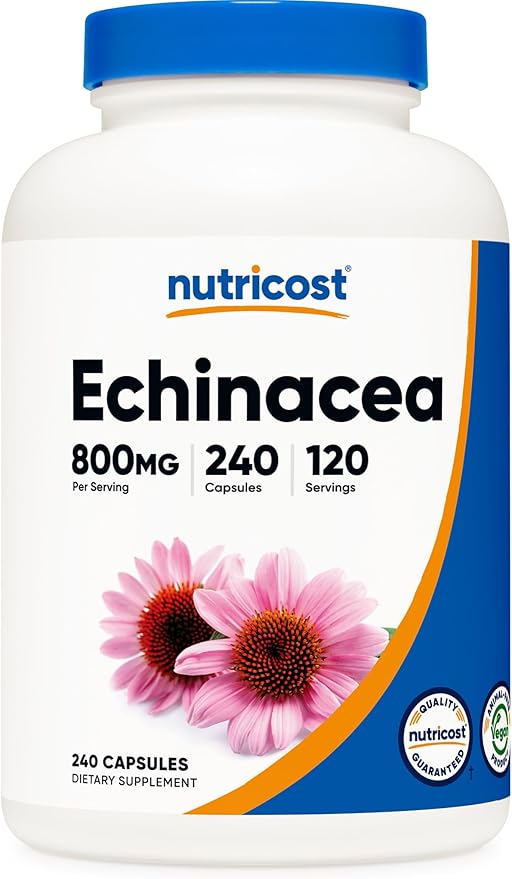
Check that the label names both the species and the plant part. Species and preparation vary wildly between products, which is a large part of why the trials do not replicate.
Buy on Amazon
States Echinacea purpurea and the aerial part on the front of the label — the only one of the three you can match against a specific trial.
Buy on AmazonPrefer to compare yourself? This opens Amazon’s full selection for this supplement, filtered to the form we recommend.
See all on AmazonEvery result, next to the line that means no effect
Each diamond is a study's best estimate. The thin line shows how sure the study was: the shorter the line, the more certain the result.
- URTI incidence (prevention)% relative risk · David & Cunningham 2019, Complement Ther Med−22.0−32 … −12
- Prevention, post-hoc pooled estimate% relative risk · Cochrane 2014 (Karsch-Völk); reported as a 10–20% range from post-hoc pooling only−15.0[not given]
- Illness duration (treatment) — crosses zerodays · David & Cunningham 2019, Complement Ther Med−0.45−1.85 … +0.94
Each unit gets its own scale, so numbers are never mixed on one line. When a study gave no range, we leave it blank instead of inventing one.
3 studies over 17 years
The studies
- 1.Echinacea for preventing and treating the common coldCochrane Database of Systematic Reviews · 2014 · rct · 24 experiments · n = 4,631
Across 33 comparisons, none of the 12 prevention comparisons reporting patient episodes was individually significant; only 2 of 6 treatment trials reporting duration favoured echinacea. 8 of 24 trials were at high risk of bias. Authors concluded echinacea has not been shown to benefit cold treatment.
- 2.Echinacea for the prevention and treatment of upper respiratory tract infections: A systematic review and meta-analysisComplementary Therapies in Medicine · 2019 · rct · 29 experiments
Prevention RR 0.78 (95% CI 0.68–0.88) from 9 studies; duration mean difference −0.45 days (95% CI −1.85 to 0.94), crossing zero. Significant clinical heterogeneity across preparations; no evidence supporting treatment use.
- 3.Adverse reactions associated with echinacea: the Australian experienceAnnals of Allergy, Asthma & Immunology · 2002 · rct · n = 51
Of 51 adverse drug reports, 26 were suggestive of IgE-mediated hypersensitivity: 4 anaphylaxis, 12 acute asthma, 10 urticaria/angioedema. Atopic subjects were overrepresented, and 20 of 100 atopic people never exposed to echinacea had positive skin-prick tests, indicating cross-reactivity with environmental allergens.
Umbral is a wellness product, not a medical device. It does not diagnose, treat, cure or prevent any disease. Supplement information is educational; talk to a clinician before starting anything, especially if you are pregnant, under 18, managing a condition or taking medication.
These statements have not been evaluated by the Food and Drug Administration.